Personalization & Custom Gifting
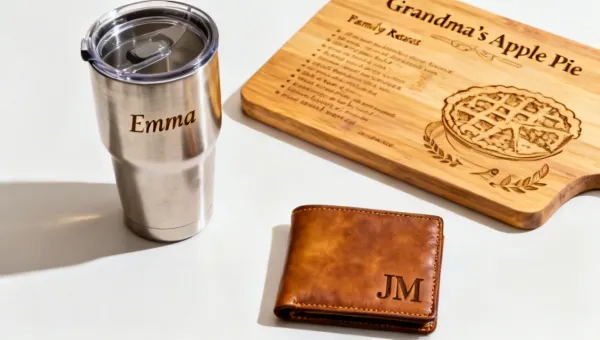
Tumblers, cutting boards, pet tags, phone cases, pens, flasks, and keychains. ComMarker desktop units let small business owners and Etsy sellers add high-margin personalization services without a learning curve.
Recommended Systems
- Omni 1 (20W-60W) - Enclosed and Class 1 safe for home office or retail counter use. Built-in fume extraction.
- B4 (20W-60W) - Open-frame desktop for makers with dedicated workshop space. Lower price point for startups.
Materials
Stainless steel, anodized aluminum, coated metals, leatherette, some plastics (ABS, nylon), coated glass.
Jewelry Engraving
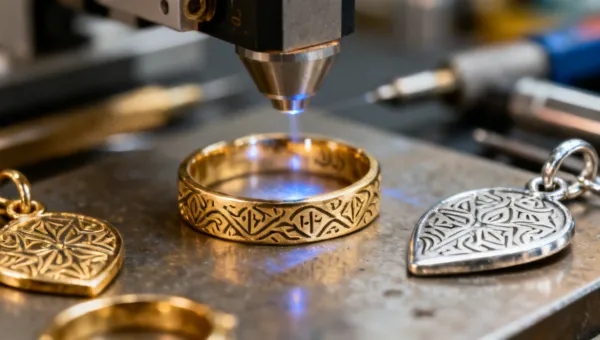
Rings, pendants, bracelets, watch case backs, and earrings. Fiber lasers produce hairline-thin engravings on precious metals without damaging the workpiece. Rotary attachments handle round items.
Recommended Systems
- B4 30W - Fine spot size for detailed work. Good balance of resolution and speed for small-volume shops.
- B6 MOPA 20W-30W - Adjustable pulse width for different surface finishes. Color marking on stainless steel and titanium adds creative options.
Materials
Gold, silver, platinum, stainless steel, titanium, brass, tungsten carbide.
Industrial Part Marking & Traceability
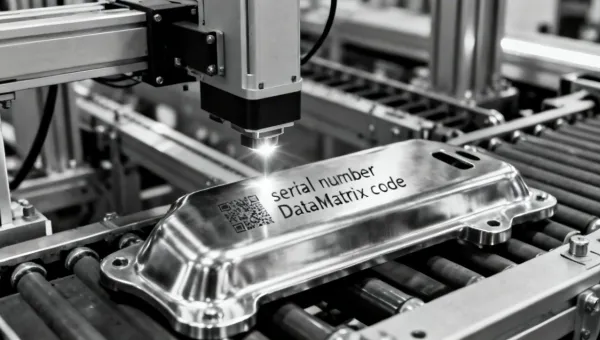
Serial numbers, DataMatrix codes, QR codes, barcodes, and compliance marks on production parts. Fiber laser marks are permanent, resistant to heat, chemicals, and abrasion, and readable by automated scanners.
Recommended Systems
- B6 60W MOPA - Production-grade marking speed with versatile pulse width control. Handles batch jobs through EZCad serialization.
- Titan 100W-200W - High-power for deep engraving and large-area marking. Suitable for integration into production lines.
Standards Supported
UID (DoD), UDI (FDA), VIN, ISO 15415 (2D barcode quality), GS1 DataMatrix.
Color Marking on Stainless Steel
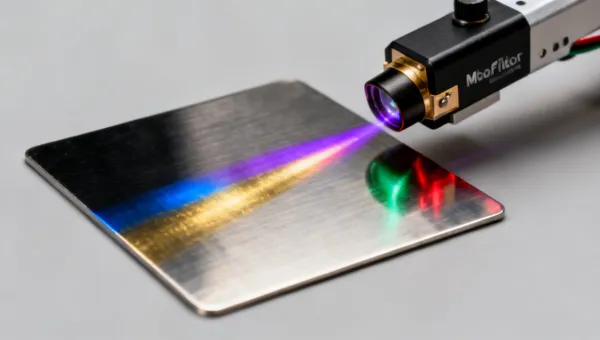
MOPA fiber lasers create vivid colors on stainless steel and titanium by forming controlled oxide layers through precise pulse width manipulation. No inks, coatings, or post-processing required. Colors are permanent and resistant to UV, chemicals, and mechanical wear.
Recommended Systems
- B6 MOPA (20W-60W) - JPT M7 source with 2-350ns pulse width range. Color accuracy depends on material grade, surface preparation, and parameter tuning.
- Titan MOPA (100W-200W) - Faster color marking on larger areas for production environments.
Achievable Colors
Black, dark blue, light blue, gold, purple, red, green, orange, and rainbow gradients on 304/316 stainless steel. Results vary with alloy grade and surface finish.
Glass, Crystal & Sensitive Material Marking
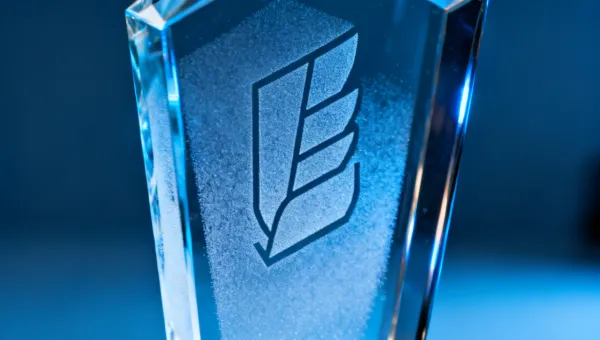
UV lasers (355nm wavelength) mark glass, crystal, ceramics, and heat-sensitive plastics through a "cold marking" process that minimizes thermal damage. Ideal for awards, trophies, cosmetics packaging, and medical devices made from materials that fiber lasers cannot cleanly process.
Recommended Systems
- Omni X (3W-10W UV) - Enclosed desktop UV laser for glass, crystal, and plastic marking. Class 1 safety rated.
- Omni 1 UV variant - Same enclosed platform with UV laser source option.
Materials
Borosilicate glass, soda-lime glass, K9 crystal, PE/PP/PET plastics, silicone, ceramics, PCB substrates.
Education & Makerspaces
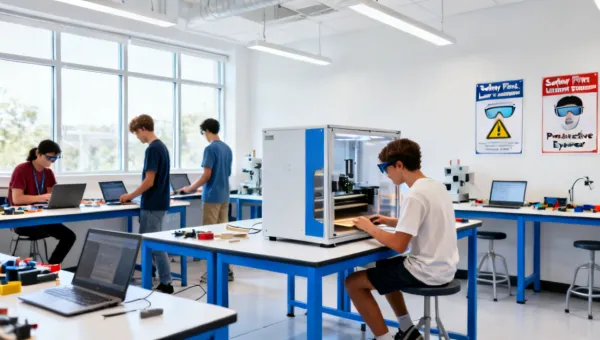
Schools, universities, and community makerspaces need laser systems that meet safety requirements for shared environments. The Omni 1 enclosed platform carries a Class 1 laser safety rating (IEC 60825-1), eliminating the need for laser safety officers, dedicated rooms, or safety eyewear during operation.
Recommended Systems
- Omni 1 (20W-60W) - Class 1 enclosed design. Door interlock. Built-in fume extraction port. Suitable for unsupervised lab environments.
- Omni X UV - Same safety profile for cold-marking applications on glass and plastics.
Safety Certifications
Class 1 Laser Product (IEC 60825-1), CE, FCC, FDA. No additional PPE required during normal operation.